If Your Marriage Could Be Something Better Six Months From Now, What Would That Look Like?
Stop trying to win the conversation
Start understanding what's really happening beneath it
Most relationship problems are not caused by a simple lack of communication.
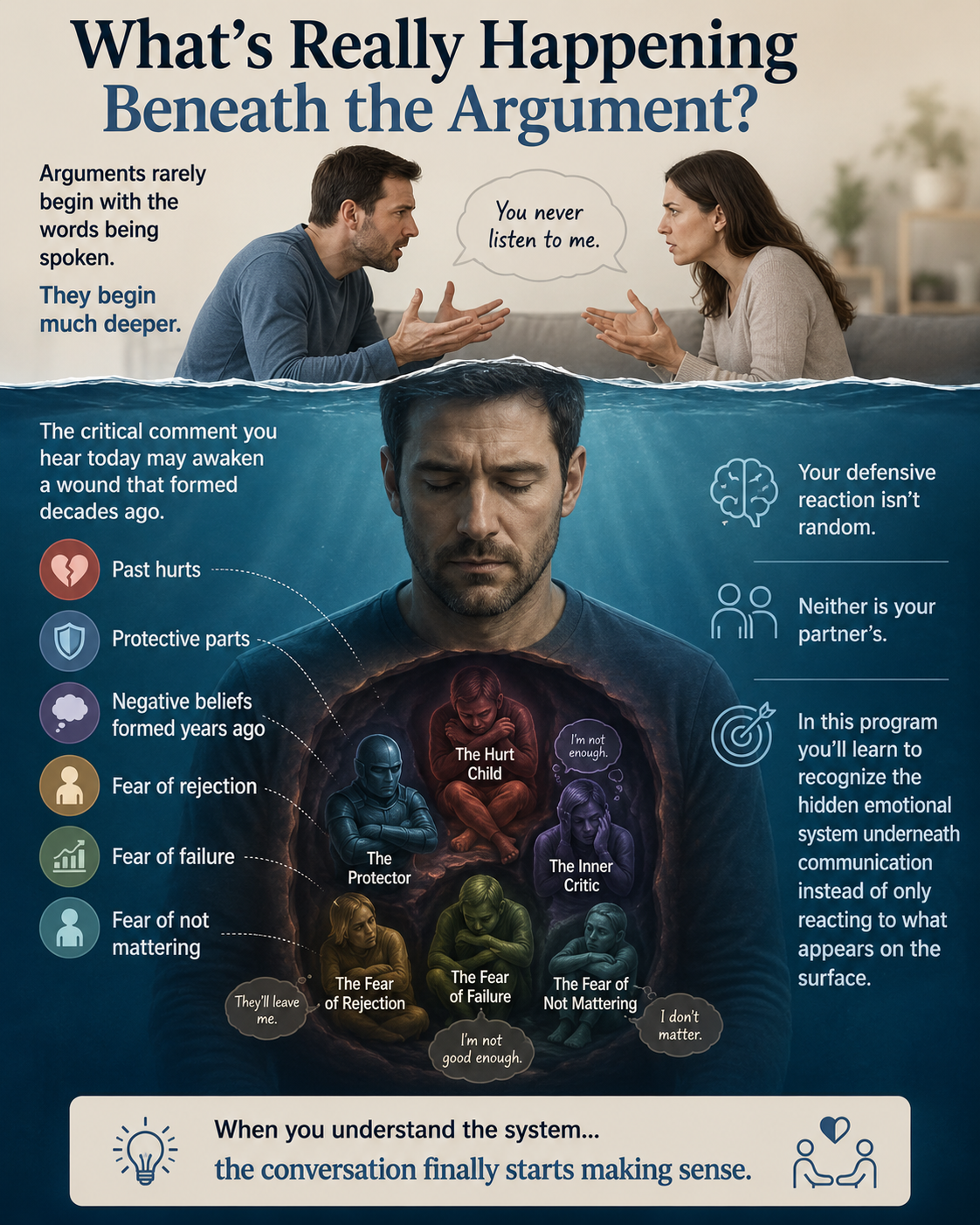
They are shaped by the complicated things happening underneath the conversation:
As soon as you start talking together, the problem becomes your Interpretations. Your Defensiveness. Fears. Old wounds. Negative self-beliefs. Protective parts. Unmet needs. Competing motives. Self-serving biases. And Repeating patterns.
Two human minds trying to make sense of each other when life is getting harder and you start to lose trust in the other person and their reasons.
But...have you noticed that two people can experience the same interaction and walk away with completely different versions of what happened?
That is why simply telling people to “communicate better” is often not enough.
You need to be able to see what you're in.
When you're standing in the middle of a relationship problem, you can usually see what's directly in front of you: what your partner said, what they did, and why you believe they're wrong.(funny how it usually feels like we're right and they're wrong)
But that's a little like trying to find your way through a maze while standing inside it. You can see the wall(their attitude/behavior) in front of you. But because of the internal bias inside our minds, you might be allowing yourself to see what's going on with both sides of the relationship.
Beyond the Argument helps you get above that "maze".
You begin to see how the pieces fit together—why certain conversations keep going wrong, what is driving your reactions, and how the two of you keep getting pulled back into the same patterns.
And when you can finally see the pattern, you can stop simply reacting to what's in front of you and start responding to what is actually happening.
When communication keeps breaking down, trust has been damaged, addiction is affecting the relationship, your marriage is approaching a breaking point, or you feel like the only one trying, it can be difficult to know what to do next.
That's what these programs are designed to change.
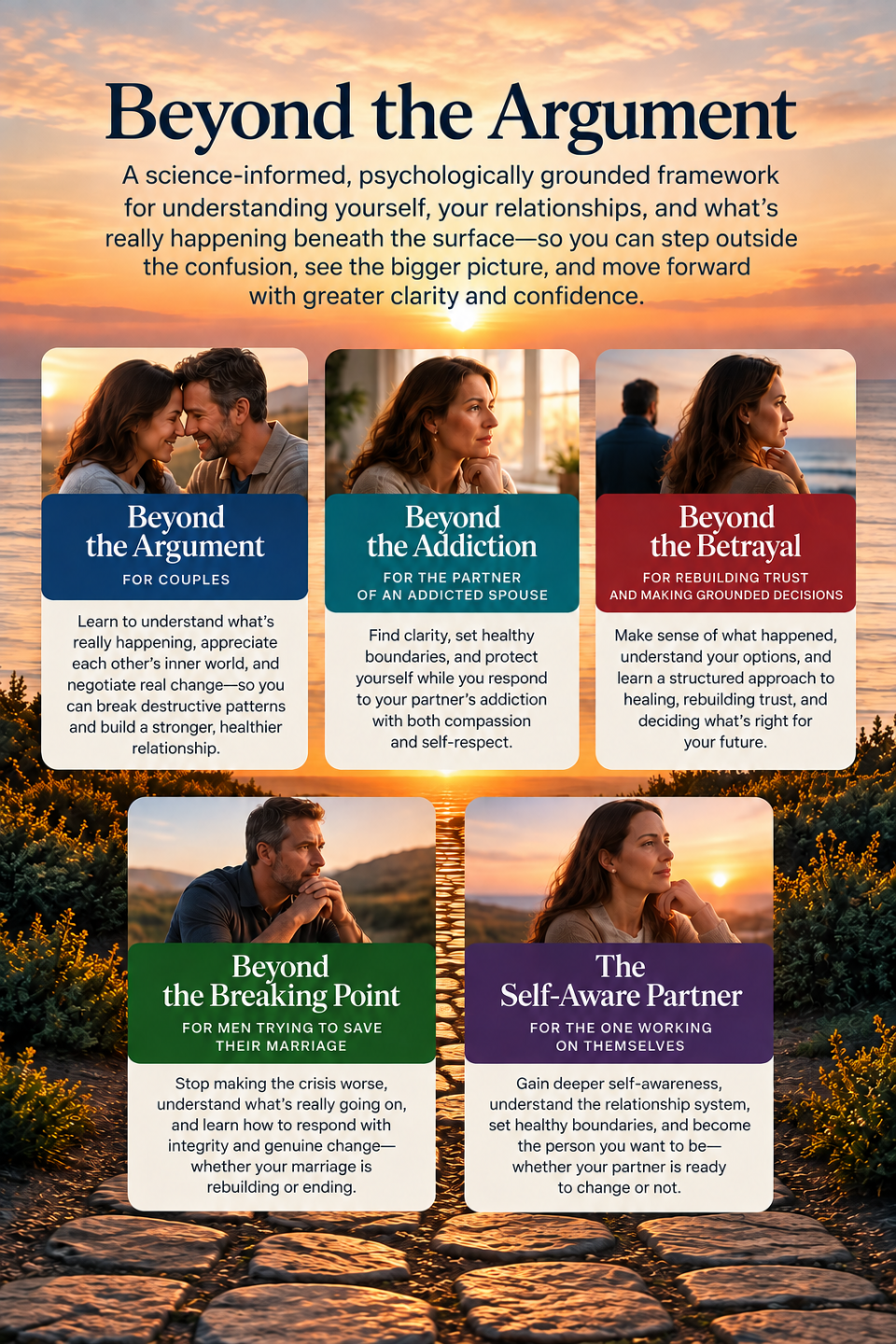
Beyond the Argument offers five specialized programs that help you step outside the confusion, understand what's really happening, and see your situation from a completely different perspective.
You'll learn to recognize the patterns that have kept you stuck and understand your own reactions more clearly. You'll gain practical tools for changing what happens next.
The goal is not simply to help you have better conversations. It's to help you see your relationship differently—because when you can see the whole system, you can finally begin changing it.
Five Different Situations. Five Clear Paths Forward.
Explore The Five Programs
Increased Support
The program is designed to provide all the teachings you will need to accomplish your goals, but if you would like text/email support and personal meetings to discuss barriers you are facing, schedule a call here. I'll personally respond within 24 hours and help you determine the next step.
Which Program Fits Your Needs the Best
1. Beyond the Argument Program
Transform the Way You Understand, Communicate, and Resolve Conflict
You love each other—but somehow your conversations keep becoming defensive, painful, or unproductive.
The Beyond the Argument program helps couples move beneath the surface of recurring conflicts. You will learn why seemingly simple conversations become emotionally charged, how past experiences and protective reactions shape present disagreements, and how to create conversations in which both partners can feel understood without either person surrendering their needs.
Through the Understand–Appreciate–Negotiate framework, you will develop a practical and repeatable way to approach difficult conversations together.
This program may be right for you if:
- You keep having different versions of the same argument.
- One partner pursues while the other withdraws.
- Small disagreements quickly become emotionally intense.
- Both of you want the relationship to improve.
- You need more than advice to “communicate better.”
Beyond the Addiction
Navigate Addiction Without Losing Yourself
When someone you love is struggling with addictive behavior, it can become difficult to distinguish love from rescuing, patience from enabling, and reasonable concern from an exhausting attempt to control the outcome.
You may find yourself monitoring, confronting, pleading, protecting, questioning, or continually hoping that the latest promise will finally become lasting change.
Beyond the Addiction helps you understand your reactions, evaluate promises against patterns, communicate more effectively, establish meaningful boundaries, and protect your identity while determining what responsible support actually looks like.
This program may be right for you if:
- Your partner’s addictive behavior is affecting your relationship.
- You no longer know which promises to believe.
- You feel responsible for keeping everything from falling apart.
- You struggle to set boundaries and follow through.
- You want to respond with both compassion and self-respect.
Beyond the Betrayal
Rebuild Trust, Clarity, and Connection After Betrayal
Betrayal does more than damage trust. It can disrupt your understanding of the relationship, your memories of the past, your confidence in your judgment, and your sense of emotional safety.
You may feel pressured to decide whether to forgive, trust, reconcile, or leave before you have enough clarity to make any of those decisions.
Beyond the Betrayal helps you separate those questions, evaluate evidence of genuine accountability, create appropriate transparency, understand relational risk, and determine what rebuilding trust would realistically require.
This program may be right for you if:
- You cannot stop reviewing what happened.
- New questions continue to emerge.
- You do not know whether your partner is genuinely changing.
- You feel torn between hope and self-protection.
- You want to make a grounded decision without pretending certainty exists.
CHECK PRICING FOR BEYOND THE BETRAYAL
Beyond the Breaking Point
Rebuild Yourself—and Give Your Marriage Its Best Opportunity to Heal
Your wife may be emotionally withdrawing, talking about separation, or telling you that she no longer believes things will change.
Fear can make you pursue harder, argue your case, make desperate promises, or attempt to prove your commitment. Unfortunately, those reactions can sometimes intensify the very crisis you are trying to stop.
Beyond the Breaking Point helps men slow the crisis, understand what their wife may have been trying to communicate, replace panic-driven compliance with genuine change, and become more grounded regardless of what happens next.
This program may be right for you if:
- Your wife says she is done or considering leaving.
- You feel desperate to convince her to stay.
- The changes you make never seem to receive credit.
- You are being described as “the problem” in the relationship.
- You want to respond with maturity instead of panic or control.
CHECK PRICING FOR BEYOND THE BREAKING POINT

The Self-Aware Partner
Stop Waiting for Your Partner to Change and Discover What You Can Do Now
Perhaps you have suggested counseling, started important conversations, purchased books, or tried repeatedly to improve the relationship—but your partner remains defensive, dismissive, or unwilling to participate.
One person cannot create a healthy relationship alone. But that does not mean you are powerless.
The Self-Aware Partner helps you understand the emotional system you are living in, recognize your contribution without taking all the blame, communicate your needs more effectively, establish boundaries, and evaluate the relationship as it actually exists.
This program may be right for you if:
- You feel like the only person working on the relationship.
- Your concerns are repeatedly minimized or avoided.
- You are exhausted from trying to motivate your partner.
- You have started questioning whether your needs are unreasonable.
- You want to grow without abandoning yourself.
You Do Not Need Another List of Communication Tips
Relationship problems are rarely caused by a simple lack of information.
Most people already know they should listen, remain calm, express their feelings, and avoid becoming defensive. The real challenge is understanding why those abilities disappear when the conversation becomes emotionally important.
Beyond the Argument programs help you understand:
- The emotional reactions operating beneath your words
- The fears and beliefs that make conflict feel threatening
- The protective “parts” that pursue, withdraw, criticize, appease, or control
- The repeating relationship patterns that keep both partners stuck
- The difference between influence and control
- How to combine compassion, accountability, boundaries, and self-respect
The goal is not to help you win the argument.
The goal is to help you understand what is actually happening—and respond in a way that reflects the person you want to be.
Different Programs. A Shared Foundation.
Every Beyond the Argument program combines practical relationship education with deeper emotional understanding.
Depending upon the program you choose, you will receive:
- Structured video lessons
- Guided exercises and assessments
- Practical communication frameworks
- Tools for identifying patterns and protective reactions
- Help evaluating accountability, trust, boundaries, and change
- A clear process for deciding what to do next
You will not be asked to deny painful realities, accept responsibility for another person’s choices, or pretend that better communication can solve every problem.
You will be encouraged to become more honest, thoughtful, emotionally grounded, courageous, compassionate, and clear.
Increased Support
The program is designed to provide all the teachings you will need to accomplish your goals, but if you would like text/email support and personal meetings to discuss barriers you are facing, schedule a call here. I'll personally respond within 24 hours and help you determine the next step.
SCHEDULE A DISCOVERY CALLMeet Robert Brown
Relationship Education Built From Years of Helping Couples Understand What Happens Beneath the Argument
I am Robert Brown, a Licensed Professional Counselor and Certified EMDR Therapist with more than ten years of experience helping couples navigate conflict, emotional disconnection, painful relationship patterns, and difficult decisions.
Over the years, one question has continued to guide my work:
How can two people who genuinely love each other end up hurting each other so deeply?
The Beyond the Argument programs grew from my effort to answer that question in a way that is emotionally insightful, practically useful, and respectful of the complexity of real relationships—so you can step outside the confusion, see the patterns that are keeping you stuck, and understand what needs to change to create a healthier path forward.
LEARN MORE ABOUT ROBERT
Increased Support
The program is designed to provide all the teachings you will need to accomplish your goals, but if you would like text/email support and personal meetings to discuss barriers you are facing, schedule a call here. I'll personally respond within 24 hours and help you determine the next step.
Begin With the Situation You Are Facing Today
You may not know what will happen to your relationship.
You may not know how your partner will respond.
You may not have every answer you wish you had.
But you can begin developing the understanding, judgment, communication skills, and emotional strength you need to take your next step wisely.
Explore the Five Programs